Can anti-capitalism defeat convenience?
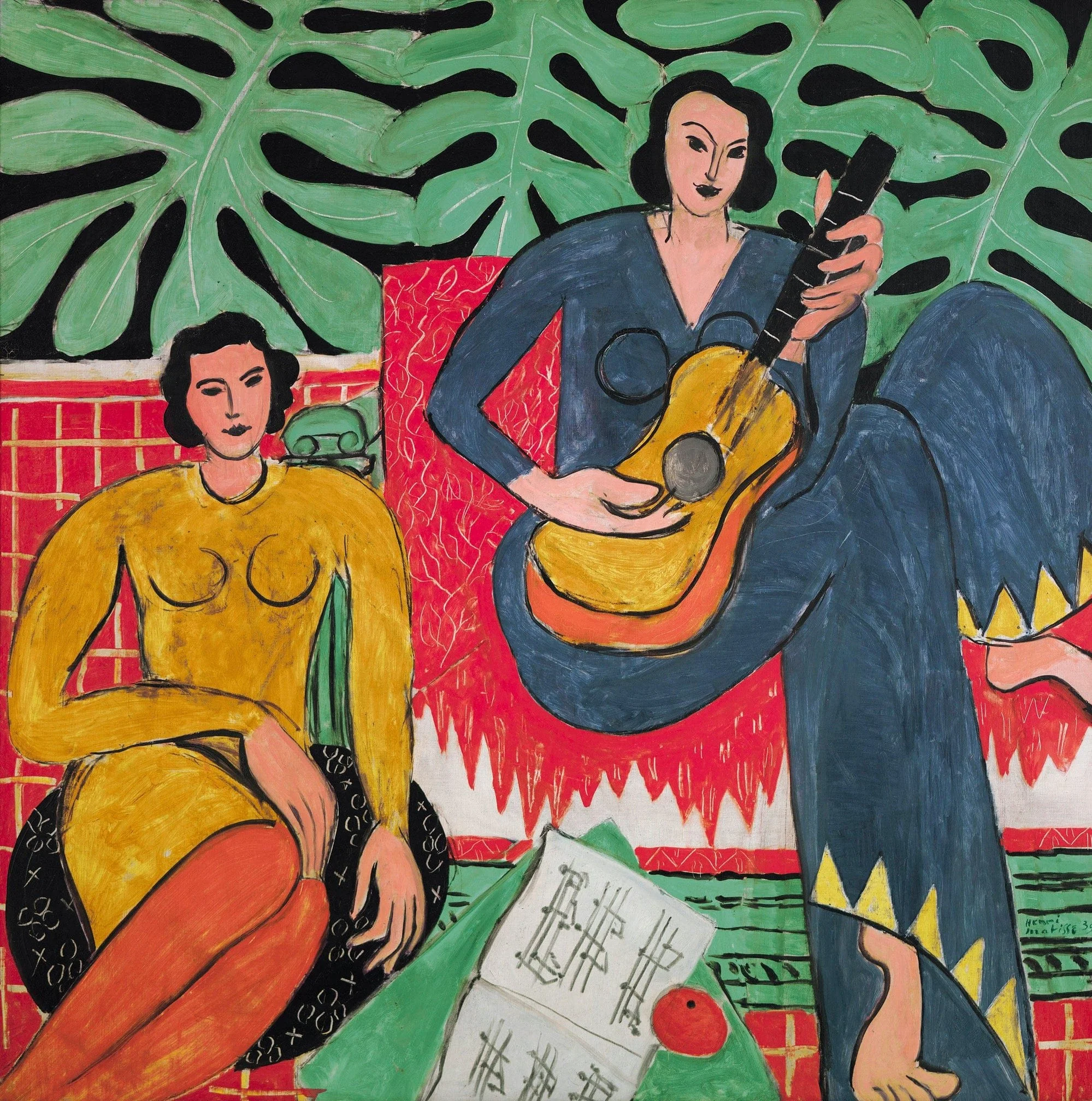
Marisse’s La Musique’s “aim was to show man's attainment of a state of completeness by immersion in creativity”.
Spotify has faced criticism before. Taylor Swift, Joni Mitchell, and Thom Yorke have all removed their music from the platform in the past, only to sneak back in.
It’s happening again now, seemingly more publicly and extremely. It’s not just artists boycotting the platform, but users as well. Personally, my Instagram and YouTube feeds have fed me a lot of videos talking about something along the lines of “how to find new music without Spotify” (this one is quite good, to be honest). So naturally, when a friend sent me an article titled “I can see a world where Spotify doesn’t exist”, I clicked immediately.
In it, they mention Cantilever, a crossover of BBC Radio 6 and Mubi, which curates 10 monthly albums and matches them with in-depth articles about each one.
It’s founder, Aaron Skates’ response to the current media landscape, which as we know, can treat music as a product first and art second. Thanks to the algorithmic nature of major streaming platforms, songs have to appeal to that very algorithm to get more streams. So they become easily digestible, forgettable background music, and our connection with the art takes the back seat.
Across various fields, people have begun to antagonise this god-like Algorithm. More emphasis is being placed on value and connection. It feels like since Covid, the development of technology has coincided with an overall cynicism around it. It’s confusing, we’ve never hated algorithmic platforms more, but we’ve never been more addicted.
But one thing is for sure: people hate billionaires, and people hate AI. So when Daniel Ek’s investment in Helsing (German AI-military tech company) was made public, people had enough. Now it’s personal, this exodus feels different. But is it permanent?
That’s what Aaron and I discussed last Thursday afternoon. I was admittedly quite nervous, but mostly excited to pick his brain about the current landscape. He started in 2014 as a music journalist, before eventually moving to independent distributors and labels. Now he’s taken that knowledge to the tech world to develop Cantilever.
How did we even get to this point? Aaron calls us back to the days of iTunes, which “unbundled the track from the album. That started the chain reaction of it being a cheap, short format that will be infinitely dissected into these discrete units of three minutes.”
That’s why we’re having this discussion in the first place. Well, that and the fact that music has such a low barrier to entry that theoretically, anyone can do it, thanks to “the line between professional and amateur in music being incredibly thin,” Aaron explains. “You have the big budget artists who are making things in professional recording studios, which cost a lot of money, huge campaigns, big arena tours, and so on. And then at the same time, I can make a beat on Ableton in my bedroom today and put it on Spotify.”
Music streaming platforms allow for everything, the professional and the amateur. So naturally, there is an inconceivable amount of music uploaded every day. Specifically, as Aaron reminds me, 60,000-100,000 daily uploads, which “is just simply too many. That's more than you could listen to in a human lifetime, I imagine.”
Because these platforms focus on “quantity over quality”, we end up having a shallow experience with the music, and the music itself ends up sounding very formulaic to compete with the millions of other tracks on the platform. This mind-boggling amount doesn’t just devalue our interaction with the music, but it also partially explains why artists get paid so little from streaming.
“The fact that Spotify does exist feels more against the odds than a future in which there will be different platforms that cater for different needs.”
Aaron explains, “on Spotify, all user revenue is pooled into one central location. Then it's divided up by percentage share on the platform. Let's say one of the biggest artists in the world—let’s say it’s Drake—gets 1% of all Spotify streams this month, then he gets 1% of that revenue pool. And therefore, Drake has a 1% of your and my subscription, whether or not we listen to him. But if you pay for Cantilever and you only listen to one song, that song will get all of your money.”
He does repeatedly highlight that while this is their attempt at ensuring the money goes straight to the artists, Cantilever does not compete with Spotify. “We can't solve the problem of paying all artists more, even though I wish that we could. And part of the reason is because it's not a problem that can be solved by a platform like ours, that's also trying to solve that problem of deeper engagement. I think if there's going to be a movement towards fair remuneration across the board, then that's for those big digital streaming platforms to take on”.
Hence the boycotts. Many users have become aware of the painful reality of streaming platforms: get paid a fraction of a cent, and if you have less than 1,000 monthly listeners, get paid nothing.
“Spotify saved the music industry. And that’s a really important caveat. It didn’t save music. Music is going to be around forever.”
That said, I unfortunately agree with the claim that Spotify saved the music industry. As Jane Lee explains, after Napster was introduced, “the music business almost ran out of business”. Then iTunes famously “unbundled the track from the album”, solving the problem of ownership, and Spotify solved the problem of access. In Aaron’s words, “There is an argument to say that digital streaming has solved the problem of music. We now have the ability to access the global history of recorded music whenever we want. And there is very little that isn't on streaming platforms.”
But while Spotify saved the industry, it didn’t save the art. It just saved the money-making machine and music’s hyper-production. This art has never been more commodified, optimised, and marketed. The good news is that people are talking about it.
People want more value and connection with their music, which is where Aaron “really pitch(es) Cantilever because some people have said that it's a platform to discover new music, and I don't think so, because of various reasons. There are a million places to discover new music. The difference between that and Cantilever is we're prioritising a very durational and deep experience of engaging with music.”
In Aaron’s words, “there's a big difference between the music industry and music culture. Music culture is made in communities. It's made between people. It's real. You can participate in it. It forms the backbone of a lot of people's lives and communities. And that is incredibly important.”
In his eyes, independent labels like Hyperdub or Warp Records are the way to go. They “care a lot about music culture and where the sounds and the scenes that they're supporting are coming from. So, yes, Spotify saved the music industry. And that's a really important caveat. It didn't save music. Music is going to be around forever. And it will necessarily take different forms.”
There’s also a case to be made for old-school music journalism, on which Aaron also places immense importance (naturally, since he was a music journalist). And personally, I think music journalism might see a bit of a rise, even if it takes on a new form. In our rejection of the algorithm, we turn back to curators and tastemakers. But maybe we’ve evolved past straightforward reviews onto something more nuanced.
“Music journalism, I think, is good when it gives you more than just, “this is what the artist sounds like”. But what's going on culturally? How can I get a thread of something different to deepen my understanding of this world? Sometimes that could be the recording details, or the scene that the artist is coming from, or as simple as why this album was under appreciated in its time. So, there's many different ways in which it works.
And this is where the Liz Pelly book—which I loved reading—it does this thing that I see happen in quite a few articles, where we're talking about your massive capitalist platforms on one side. And then we're talking about the experience of actual art and music community, which is happening in a physical space and between quite a small number of people, on another side. There's not so much in the middle ground. Cantilever exists in that middle ground. It's attempting to do something like the user journey I described before of wanting people to find things on here and think it’s valuable, but I have absolutely no interest in having an addictive app experience. I want people to use it, find it valuable, and then go and do something in real music culture.”
In that, he also shares his admiration for cultural theorist Mark Fisher, who “when he wrote about music, it was always about how music could be read by the cultural conditions that produce it. His famous essay about Drake, If You Have Everything, Why Are You So Sad, remains to me one of the best examples of music journalism. He was writing about the music that he liked, and about how certain sounds reflect the culture that they're a part of. That that's what I'm trying to achieve with the writing on Cantilever.”
So where do we go from here? Are we as consumers ever going to move past this big streaming platform format? Or are we too stuck in our ways, and there will be things like Cantilever that exist on the side, but don't replace it?
I asked Aaron this exact question, to which he answered, “Anything could happen. That's my view. There are no fixed parameters in how people want to engage in culture. I mean—and again, I'm not attempting to do this by any stretch—but when you look at film streaming, every platform has its own content. And could that happen to music streaming? It's almost a surprise that it didn't start that way. Because the way Spotify put forward the concept of legal streaming, its success is down to the fact that it has everything. Could it at some point not have everything? And could another platform be the place where you pay for independent music in addition, and if you want Bob Dylan and Michael Jackson and Taylor Swift, you go to Spotify? Maybe.
I think if you could imagine a film streaming service entering the market today like, “we're going to host all of the films that have ever been released and will ever be released and you pay £10 a month for that,” people would say that's impossible. So the fact that Spotify does exist feels more against the odds than a future in which there will be different platforms that cater for different needs.”
This answer is so simple that it makes me wonder how I’ve not drawn this comparison myself. It’s possible that as we become more aware of societal inequalities and billionaires face more scrutiny from the public, monopolised platforms like this might face a decline in their subscriptions, and our music consumption is more scattered across several sources.
“There’s a big difference between the music industry and music culture. Music culture is made in communities. It’s made between people. It’s real. You can participate in it. It forms the backbone of a lot of people’s lives and communities. And that is incredibly important.”
Still I think a somewhat bleak but necessary reminder is that the people to which this topic matters most is not the average listener, who draw the most sales, and who prioritise convenience. And that’s what Spotify thrives on. Hence, Aaron doesn’t see Cantilever “as something that somebody would move on from Spotify to”, but rather something that coexists with the major streaming platforms. That said, there are others who disagree.
So how effective are these boycotts? Of course, as with any boycott, its strength is in numbers. It’s possible that if only the most impassioned users leave the platform, that’s not enough to make a big change. And if people swap Spotify for Apple Music, that makes no significant difference, we just swap one major corporation for another. If I can be so bold as to use a Brazilian expression, nós trocamos seis por meia dúzia. Sure, Tim Cook isn’t publicly investing in military technology, but iPhone production is hardly ethical.
And although artists have more power (if they remove their music, fans have to listen to it elsewhere), their music is often still available on other platforms. That’s not to say that artists shouldn’t do it—I fully support anyone’s decision to remove their music from Spotify—but I just question the effectiveness of boycotting Spotify alone, especially if one’s motivation to do so isn’t just the military investments but also minuscule pay for the artists.
In short, these boycotts and this rage are symptomatic of something larger. Spotify is far from the only culprit, it’s just an extremely popular reflection of the industry’s greed. And the exodus from it is emblematic of the rise in anti-capitalist, eat-the-rich-ification of post-pandemic society. Those years opened our eyes to the value of art (it was what kept many of us sane when locked at home), and the industry’s monetary and emotional de-valuation of it.
As for where we go from here, only time will tell. But the introduction of platforms like Cantilever, Nina Protocol, and Vocana showcase the “turning against these platforms”, as Aaron puts it.
One way to fight this is remember what music is about: connection, self-expression, community, emotion, vulnerability, play, creativity. The best ways to support the artists you love has never changed. It’s not streaming a song at low volume while you sleep, it’s going to shows, buying the records, building community, doing something real.
The reality is that Spotify and Apple Music aren’t disappearing anytime soon. But they could, as this anti-Spotify sentiment resonates not just with music devotees like Aaron and I, but with anyone who rejects AI, hates billionaires, is overstimulated by algorithms, and fears war. That’s a lot of people.