Meet your new favourite small-town punk
I chatted with Evan Minsker, ex-Pitchfork writer who now runs see/saw, about local punk scenes, algorithmic music listening, and the importance of community
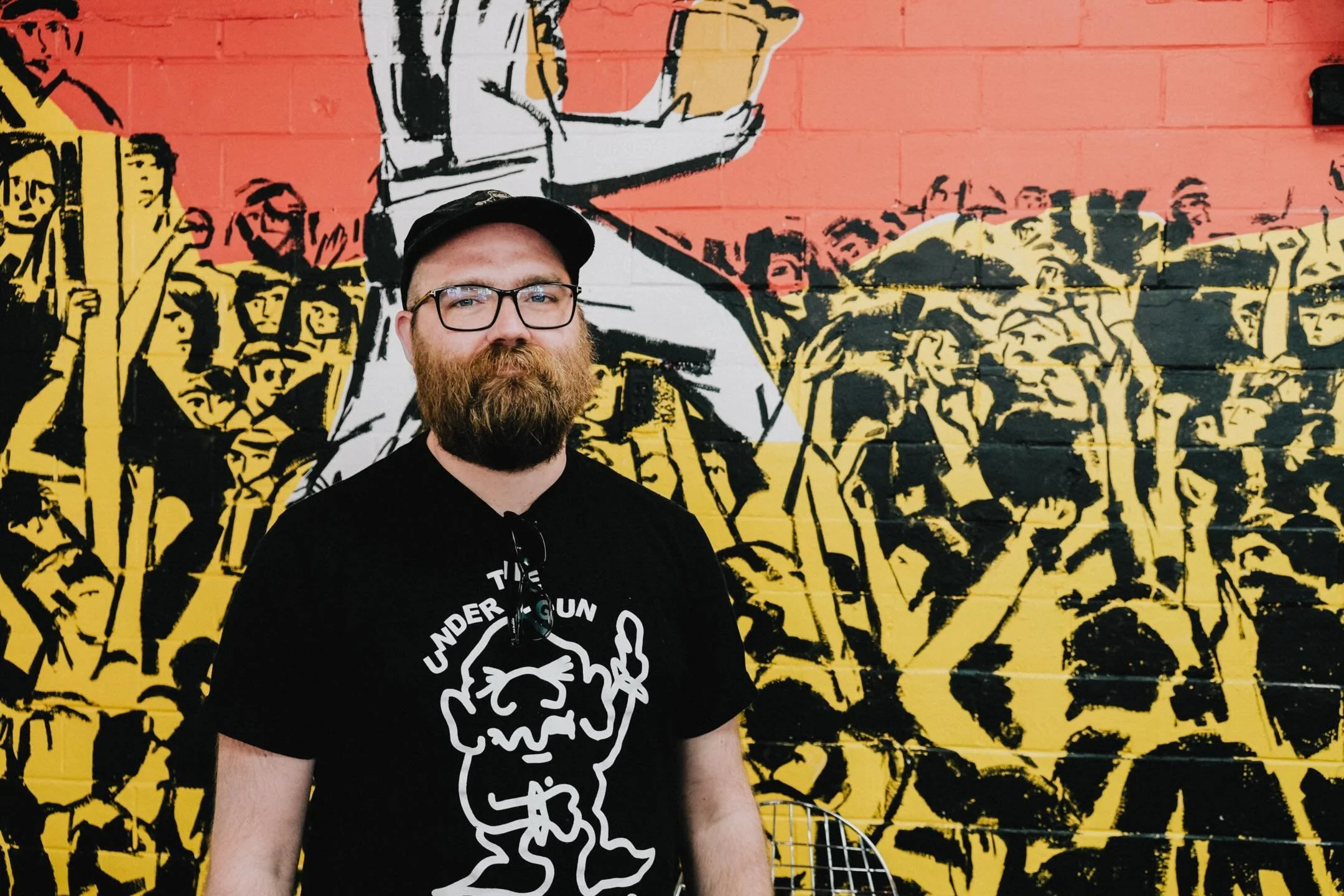
Evan at a local record shop, shot by Mayson Rainwater.
Here’s what it’s like chatting with Evan: he is almost perpetually excited, and the main way to tell if he’s smiling is through the slight movement of his moustache, unless he lets out his hearty belly laugh. He name drops like crazy (not a diss), is surrounded by records and tapes, and won’t be caught dead in anything that’s not a band tee.
I came across Evan last December through old-school late-night internet-digging and seeing “see-saw.fun, punk & rock ‘n’ roll newsletter”. I clicked, I browsed, I subscribed, I emailed him within 5 minutes.
I didn’t really expect anything, much less a response as quick and friendly as his. So we scheduled a call for the following week that worked across our seven-hour time difference, and I got to planning questions.
We started with his rundown of how see/saw (or as Evan likes to call it, seehyphensawdotfun) is structured: the “firehose of music” that is the radio show; his “non-eloquent” but endlessly entertaining podcast co-hosted with Nina Corcoran; and last but not least, the writing.
“Writing on see/saw, especially the weekly column, is very loose. I make up a lot of shit in the column. I've come up with a lot of genre signifiers that I don't think really exist.” But there is a method to his madness, including the “sort of personal” blogs, the slightly more analytical essays, and “very research focused” features. For these, he interviews artists sometimes, and other times invites friends to contribute. You should check out Rocco Tenaglia's recent Mod Lang interview.
READ MORE | A (NOT SO) BRIEF HISTORY OF PUNK
We started the conversation by briefly touching on imposter syndrome. Evan admitted to feeling it “all the time, constantly. I'm a fan before I'm an expert. (…) But I can’t deny that I enjoy this stuff deeply, and I do probably have some expertise in very specific areas of punk.”
He uses this curiosity and his community to deepen that enjoyment and expertise. Becoming obsessed with punk music from 1997, he made a mixtape and a Discord channel dedicated to the year. After offering to email me a song by Lung Leg, we covered the importance of community in finding new music, a topic that frequently comes back in our conversation.
“I think [the see/saw 1997 mixtape] was weirdly important for me. (…) In the big publications it's just very homogeneous. Everybody agrees that these are the accepted 50 records. There are a few that pop out, a few pop in, they all switch spots. But Geese will reign, Rosalía is gonna have her moment. Everybody likes the same stuff, so I started see/saw because I prefer understanding a canon of underground punk music that genuinely exists in the world. I like doing that, because 2025 is an incredible year for punk music, and you're not gonna know that if you only read Pitchfork, Rolling Stone, you know, whatever.”
Over the course of nearly two hours, Evan and I talked about community, local venues, Pitchfork, algorithms, escaping the mass media bubble, capitalism, small shows, and what is punk.
Do you ever get overwhelmed with the amount of music out there?
[laughs] I’m a sicko, so no, I don't get overwhelmed. What's really funny about you asking me that question; I’m gonna share my screen. So about 10 years ago, early in Spotify, this guy was gaming the Spotify algorithm to just put out basically an album a day, that was just songs that he barely wrote, that are him just free-styling in front of a keyboard, and singing somewhat tunefully, and it was just SEO grabs. He did a whole record about actual music critics, and one of the songs on a record that he made 10 years ago, was called Evan Minsker, You Ever Get Overwhelmed by All the Music Out There?
But people ask me about it sometimes. I remember at the time, somebody had googled me and was like, “hey you ever hear this song?” I was like, “yes, I've heard it, no comment” [laughs]. But now I think about it, it's actually honestly a very prescient commentary on who I am as a writer.
Because I do get it, it’s a lot, it's a fire hose, punk music never stops. Especially with Bandcamp Fridays now, there’s a one-day inundation of both really good music and just kind of cast-offs, b-sides, all that stuff. It’s helpful to have been doing it for as long as I've been doing it. Because for example, this last Bandcamp Friday, I think it's easy to say maybe 40-some records all came out. And it was easy to play, listen through a little bit of it, and if it's not grabbing me right away, I'm just gonna put it in the “what else” paragraph, and just say, “check it out if you've got time, but I'm gonna focus on other stuff”.
I think it also helps that I treat the column like a nine-to-five on Friday. I wake up, I write about punk music, I finish writing about punk music, I log off, I have dinner with my family, you know what I mean? [laughs]
I do worry about people feeling overwhelmed by the firehose of coverage of see/saw, but that’s what the podcast is there for. It’s for certain people who like taking in information in a sort of controlled way.
The other thing is that the column [is] behind a paywall except the first blurb, because I always just feel like if you don't want to pay, that's fine, here's one record this week that you can listen to and think about.
“I’m kind of just on this very, very long, gradual walk towards getting my ass kicked.”
Thinking about the punk mentality and ethos and approach, a lot of my favourite punk songs aren’t the super angry fight the power ones, they’re the funny ones.
I've always called [see/saw] a punk and rock and roll newsletter. I think when you get into punk, the first thing that you get into punk with is sort of your defining punk emotion, or aesthetic, or whatever. I feel so jealous of people who got in through anarcho, or really serious righteous political punk rock, because I got in through the Ramones, who were a formulaic goofball rock and roll kind of thing. So I think [the URL ending with] dot fun maybe actually is the emotional approach from which I come [laughs].
But that's good. I got in through Mini Skirt. I also even talked with them about punk fashion, and they described it as cosplay. Whereas a lot of the classic artists usually just wear a t-shirt and jeans or something.
I love it. There’s this place called Extreme Noise Records in Minneapolis, they sell leathers, you can get studs, they do custom leather work in there, millions of back patches for every band from all of punk history or whatever. So you can walk in as a teenager and be like, “I am a punk today!” And just walk out fully leathered.
I went to an all-ages show at Seaward Café. Hardcore show. And not to be rude, but I feel like there are three types of people, right? There’s me, [in a] t-shirt, jeans, looking pretty regular, looking like an old guy. And then there’s the South Minneapolis DIY set with a mullet or really short jean cutoffs, piercings, tonnes of tattoos, sleeveless tees, whatever. And then the third group was the leather punks who were fully just with spiked hair, chains, leather, tonnes of stuff.
And the people wearing the leathers were the youngest by far. These are kids who don't have necessarily a robust punk community to pull from. So they’re coming in as hot as they can and just saying, “I love this, let's go”. And I relate to it and I love it. Because then it's like armour and you’re coming into this space and you're saying, “I love this stuff so much, but don't you fuck with me. I'm a 14-year-old and I'll kick your ass”. And you probably will.
You mentioned the thing about imposter syndrome and I do feel like an imposter and I also feel like I'm kind of just on this very, very long, gradual walk towards getting my ass kicked. [laughs] I just feel like one day I'm going to go to a show and I'm going to turn around and somebody's just going to kick my ass for something, and I won't know what. I’m running my mouth constantly so I don't know who I'm offending or what the problem is, but I feel like that is just looming above me like a dark cloud.
But if it happens, it'll be a fun story. I'll talk about it. I won't stop. I'll probably just keep being like, “hey, I really got my ass kicked the other day” [laughs]. And then I'd be a sympathetic martyr for the cause or something, I don’t know.
How much do you think that growing up where you grew up affects your approach to music? Did you feel like you were in a subculture or did you kind of just like it?
I didn't feel like I was in subculture actually. I felt like I got a taste of subculture in what I think you probably grew up with [in Brazil], which was just a real understanding of mass media as it relates to what’s visible. When I grew up in Huntington, West Virginia, it's a college town, and the culture was very much drinking and football. In terms of what concerts came to town, it would be classic rock bands or the occasional big pop star or something like that. But it was really quite rare.
Most of my music literacy at the time before I became a Pitchfork reader was classic rock radio, classic rock bands coming to town, nu metal bands coming to town, all that kind of stuff.
I moved to Chicago for college. There aren't all ages spaces in Chicago, you’d have to be 18+ for some shows, 21+ for most shows. So I was in kind of a weird spot in college where I could go to a lot of big indie rock shows because those were 18+.
But then I lived in Michigan for 10 years and I was near Detroit, and I started going to punk shows all the time because there were actual punk shows. There was an actual punk scene. There were actual people you could talk to and hang out with who are into that stuff. And there was a punk scene in Chicago too, but it was just not accessible to me as a person who was young.
I think that maybe it's becoming more accessible to be a small town weirdo. I'm currently a small town weirdo who loves crazy music, and I wear it as a badge of honour, but I think the internet probably has started to democratise that a little more. Now you can have online friends and just meet once a year at a punk festival or something like that.
But being close to Minneapolis's punk scene is a huge deal for me because I think it's always been a really strong punk scene, but it feels like in the last couple of years, it's been wild what's coming out of Minneapolis, in terms of new bands, new records, the shows. It's amazing to be at least close enough to a punk scene that you can go and experience and observe and hopefully not freak people out by talking about it.
“I think that [there’s an attempt to strip] curation and context back in a real way to benefit quick money-making for the very, very rich. And I think we can all do better. I think that we can all be searchers who live in our own moment.”
I always find it interesting how to escape that mass media bubble, especially because in the Netherlands, there's the language barrier for a lot of people. And I find it interesting how people cultivate community or how they find stuff. I'm young enough to have gotten so used to this algorithmic way of finding things, and I always wonder how people did that without it.
When I was at Pitchfork, I feel like the way that I was finding music was kind of in the music writer bubble, and that bubble means all of like the big publicists are telling you what's new and what's good. There are a handful of indie labels that are buzzy, so [music writers are] gonna like everything from that one. And that was just an algorithm of its own kind, that was just me existing in a bubble, and now I'm kind of intentionally not thinking about what is popular.
I haven't listened to so much popular music in the last two years that I'm sure it would curl people's hair if they knew that I was a music writer who hasn't participated in some of these. But I wilfully don't wanna do that anymore and I just wanna see what happens when I’m the only searcher. I don't wanna just be in the punk echo chamber forever. This morning before we talked, I was listening to old free jazz just to galvanise for the day because I love all kinds of music.
I come from being a record collector and a music history nerd and all that stuff. But right now I think what's really exciting is just following individual people's curation instead of listening to some monolith of music criticism and music curation. I've just got some homies who are really into crazy shit and who know where to find it. I myself have ruined my email inbox by getting a million Bandcamp notifications from a million different bands and labels and micro tape labels and all this stuff. So I've wilfully started to try to shirk both the algorithm and algorithmic curation structures.
READ MORE | THE CULTURAL HANGOVER FOLLOWING THE SPOTIFY BOYCOTTS
That reminds me of [the app] Cantilever, which is introducing people to things that maybe we wouldn't get recommended by the algorithm. I notice that there is a turning towards people going back to the simplicity of things, with the one music critic that they follow, the one really cool friend that always recommends really cool albums, stuff like that.
My cousin Mark was my first record collector nerd idol a little bit. He had this massive record collection, he did college radio and he was always really revelling in the deeply obscure things that are strange and individual and human and odd. He's not a deep punk head or anything—he’s actually in a really excellent band right now that's more of a krautrock thing, sort of a psychedelic vibe. I feel like having him in my life early [made me] think about music not as this thing encouraged by the algorithm; this lean back, don't think about it, just have it on, just hit play, it'll match your vibe, whatever. Don't think about who's making it, where it's coming from, its geographical context, anything.
I remember he made me this mixtape that had all this stuff on it. And one of them was a funk song as sung by Loretta Long, she was on Sesame Street, and I remember hearing that and just being like, “this is amazing”.
So I was always interested in the people, the stories, what's going on. And basically these big tech and advertising companies are just trying to say that music is a commodity that you can just pay a small amount of money for. And then it exists all around you whenever you want. And I don't like listening to music like that. I like talking to my friends and being like, “hey, have you ever heard this person's music? Here is their story. Here is what is good about this record. Here is where they are from”. But maybe it's just cause I'm a journalist, I'm just always really hard on the who, what, when, where, why shit.
But it does make it interesting. This isn't music related, but I'm rereading Frankenstein currently, and the first time I read it, I skipped the introduction. This time I actually read through the introduction and it just made me love it 10 times more. I learned about Mary Shelley's life and what was happening in the world. And I think that can happen with any art; you go to a museum and you look at a painting, you're like, “yeah, sure”. And then you read the little plaque and you're like, “oh my God, this is beautiful”.
Oh my God, that’s a perfect book for an intro. I feel like there are a handful of classics like Moby Dick, the Brontes, any of those where when you learn about where this stuff is coming from and who the people are, it really does enrich the work.
And I feel like the fact that Spotify is deprioritising that to such a degree that it's literally taking the human being out of the work now by just being like, “hey, let's just get some AI slop in there or this lo-fi beats chill out shit or whatever”. That's just never been who I am.
I also was always kind of offended by the early Spotify Discover shit, like I understood that people found great shit from Spotify Discover. I totally get that. I'm just thinking about close friends and family members who would be like, “I heard this on Spotify and that's how I found this”. And I just sort of feel like, that’s how you found it? You didn't read a cool article about them or watch a video of them performing or, I don't know, stumble on it yourself? Why did you need this big tech company to tell you that this is good? [laughs] I'm just kind of a little piece of shit about when people are like, “this is how I found this thing”. It's like, okay, fine. But you could have dug a little more and then lied about how you found it. That's fine.
Now I think about my most formative artists, and two of them were because my sister would play them in the car, and then I just went down the rabbit hole. One of them is Fiona Apple, which is because my dad loved her. The other one is Radiohead. And Fiona Apple and Radiohead are huge, they’re not underground by any means, but it was an organic way of finding them.
Yeah, exactly. And I mean, my Ramones obsession came from my cousin Jerry, you know what I mean? When I think about my cousins, or my record collector friends, people who were really into this stuff, and would be like, “oh shit, have you listened to this? Have you listened to that?”
To me, that’s what I think is interesting about music writing as a whole, and radio, and individual curation. Because you’re actually listening to a human being telling you, “hey, I'm really enjoying this, check it out. Here's the context in which I'm presenting it”
Curation is so interesting. I think that [there’s an attempt to strip] curation and context back in a real way to benefit quick money-making for the very, very rich. And I think we can all do better. I think that we can all be searchers who live in our own moment.
And right now my truth is pretty different from what a lot of people are saying theirs is culturally, which is not trying to be critical or an asshole about it, it’s just kind of fun to come to the end of the year during list season and realise my favourite records of the year are not on any of these lists [laughs]. And that rules.
When I worked for Pitchfork, that was just kind of the way it worked. I would vote and then I would kind of quietly take off all of my actual favourites and be like, “nobody else is gonna vote for this, that's fine.” And now I'm just sort of doing the opposite where I definitely don't need to tell people to listen to Geese or whoever.
Literally right next to me, my album of the year, Citric Dummies. Split With Turnstile is what the album is called. Minneapolis band, they're great. That album cover is based on a Barry White album cover, I found out. I think all that stuff is really interesting.
“I think the best of punk is people who make things and people who can also very much support each other in a community sense.”
I saw this New Yorker article called It’s Cool to Have No Followers Now. I think something similar is starting to happen with Spotify Wrapped. Maybe it'll be “cooler” to have fewer minutes because you're actually listening to records, or Bandcamp, or whatever it is.
But at the same time [a friend of mine] mentioned the thing about a #1 country song being AI, and asked if I’ve ever considered that maybe the average listener doesn't care who makes their music, they just want it to sound good. Which was important to me, because most of the time I just talk to people who already agree with me, and I wonder what’s the overall, real-world sentiment.
I think that everything in capitalism just becomes this really big top-shelf 1% monolith and everything else under that just doesn't exist in their opinion. I think that there's a huge cultural difference between lean-back listeners and people who are just total fucking dorks for this shit. I would love it if more people engaged.
Weirdly, with what I'm doing now, I don’t think the thing that's made it better for my mental health is the music itself, I think it’s the community engagement aspect of it. Because hearing from individual people, “hey, I discovered my one of my favourite records of the year from you. You wrote this, here's how I feel about it”, it’s amazing. That’s incredible. Let’s have a conversation about it.
One of my favourite bands in the world is Tyvek from Detroit, and I reviewed their last two albums for them [on Pitchfork], and the feedback from the people in the Pitchfork world was silence, and the feedback from people in punk world was pretty much silence because punks don't give a fuck about Pitchfork. So it was a weird position to be in.
Whereas now if I write about a band who I think is incredible, and who I think a lot of people should listen to, and they don't really have any kind of visibility, if somebody says to me, “oh my god, holy shit. Who is this band? This is such a good record”, that means everything to me. Because [I want them to] support this band, go see them in concert, go buy the record, send them a message asking them to come to your town, whatever. That feels like a way bigger deal than writing for a potential audience that’s huge [but] who doesn't say a fucking thing because they're just like, “Okay, I'll add this to my playlist”. I don’t wanna write like that anymore.
READ MORE | A NIGHT IN BERLIN WITH MINI SKIRT
I think I find it so incredibly hard to do because as a writer you need to sift through so many people to reach those who really deeply care. And as a listener you need to sift through so much bullshit to find the writers. It's almost romantic in a way.
It’s very romantic. I moved to Wisconsin, where I live now, in 2019 and Covid happened and I hadn't really made any friends before Covid, and then it hit and I was sort of just locked up.
When I started see/saw, I started putting flyers up all over Eau Claire. And I was at this bar asking the bartender if I could put up a flyer somewhere, and the guy who's sitting on the stool next to me was like, “what are you doing? What's your thing?” And I was like “Here's my thing, you want to take one? Here you go”. And it’s my buddy Jordan, that was our meet-cute.
I've made more friends now locally from doing my thing, and Eau Claire isn't a punk city. So that to me feels really beautiful when people can recognise that you have an art practice that you want to nurture in this community. Or people who are excited about what you do because you're excited about what you do. That's really huge and that's meant a lot to me too.
There’s no way to put into words the value that it can bring, the fulfilment that you can get from that kind of connection.
It’s beautiful. I've made so many friends from doing this, and it's kind of bittersweet because I had a lot of really close friends when I was at Pitchfork and I don’t talk to them as much anymore. And that’s just life, you sort of drift apart, you work at other places, I get it.
I used to have this thing about “music writer world”, I had so much FOMO where I was like, “oh, I'm not in New York City, so I'm not going to this party. I'm not at this thing ,and I'm not blah blah blah. Do they even think about me? Am I even important in this world?” Then you sort of realise that you should just live in your town and be a part of your community and do what makes you happy.
I feel like I’ve shed a decent amount of wishing that I was at the big gathering. Every now and then that happens, where I wish I was at a show. But now you can just sort of be like, “yeah, I missed that show, but I'm gonna go to this show”. You can try to have your own life and not just covet somebody else’s experience.
Yeah, I also think some of the best shows I've been to have been the really small ones.
Yeah, 100% the best shows full stop are usually the ones were almost nobody's there. I've thrown some of those shows [laughs]. I've thrown maybe four shows this year. The first one Citric Dummies played and it was kind of packed out and that was really special.
And then after that I did two over the summer, all the college students were gone, nobody showed up, but those shows were unbelievable. If you showed up you would know that there's a band like Suicide in the Midwest who are extremely gay! That’s a pretty cool vibe! There's a nun whipping a fetish whip above her head while doing drum machine punk. I felt bad for the bands, but I felt great for me [laughs].
I love going to a punk show. The most recent one that I helped throw was in this bar in Minneapolis called The Fraternal Order of the Eagles Hall, number 34 in South Minneapolis, and there's three rooms where they can hold shows. There's a big ballroom, there’s a medium-sized room, and there's a tiny room, and then there’s a bar in the middle where all three rooms join.
At this particular night there was a two-step dance thing happening in the ballroom, there was some kind of meeting in the medium room, when I got there it was bingo night and then it was karaoke night in the bar. And then there was a hardcore show in the small room that I was presenting. And it's so amazing because people will be in the hardcore show and walk out, and the person who just was screaming in the hardcore show was doing karaoke of System Of A Down. You really see the community mix and mingle. The woman who's doing bingo is getting pissed because the punks are all talking too loud.
(After chatting a bit more about… quite honestly, random shit, Evan politely told me that he soon had to leave for another appointment, so I asked my final question.)
I guess my last question is just the world's most basic question, but what would you say punk means to you?
I think punk is a huge tent. There’s this corporate punk mega giant system that you see at all the big festivals and all that shit. And then there's basement punks. There’s punks that are very much of their scene. Over the last year, the twofold thing that I think is really important to me within punk music is making stuff and community. That's it. People who make things without ambition necessarily for it, without being like, “we’re gonna be the biggest band in the world”.
You know, there's that line “art for art's sake”. I really respect people who just make things in scenes and I think a lot of that comes from like, “hey my friend is in this sick band so I'm gonna start a sick band. Now my sick band has a member from that band.” I love looking at a scene like Minneapolis or Detroit and seeing how much sprawl there is in terms of people just making things.
I think one of the most punk things about the Minneapolis punk scene is that not only are people making things, but the community is such that if you go to a punk show, you’re not necessarily gonna see four hardcore bands that sound really similar. You’re gonna see one guy who's in a punk band doing his solo noise project, and then this person over there is doing their hardcore band, and this person over here is doing their crusty folky pop punk project. Everybody's just kind of doing their thing, and they're all really supportive of each other.
I think that there is a lot of one-upmanship and competitiveness and a lot of things that capitalism has truly instilled upon all of us within punk, absolutely. But I think the best of punk is people who make things and people who can also very much support each other in a community sense. That’s been really inspiring to me, to see old punks, young punks, people who are doing all kinds of shit just being like “hey I don't love that guy's band, but I'm 100% gonna go to that show. I'm gonna play that show. I’m gonna buy their shirt. I'm gonna rep them whenever I'm out and about.” That to me feels like one of the coolest things. Just being like, “hey, I can't make it to the show. Here's 30 bucks. I can't buy a ticket, here you go, set aside a button for me someday” [chuckles]. Everybody's trying to pull each other up, even if it means that everybody’s still got a day job.
“To me that’s what it’s all about, finding the art of a human being just creating for the sake of creating, I love that shit”
That's amazing, and that can also bleed into every area of life really, it doesn't have to stay within this one sound.
Yeah, I think DIY is completely ungovernable. When you think about so many genuinely massive artists that came out of DIY, you can really tell. You can really tell just from the way that they talk to other artists, the way they talk about their work, the way they talk to the press, the way that they handle themselves.
I worry about being kind of a snob bitch about people who are really popular and famous and all that stuff because people make great music who have a lot of money, of course they do. But also, I've always had this bee in my bonnet about [how] a lot of times the song of the year is one that you have a very high likelihood of never hearing. There are album of the year candidates that I wrote about [at Pitchfork] and I didn't follow up on.
Now, I’m putting together this zine of the best punk records of the year. And these are the ones that stuck with me. These are the ones that stayed with me and people helped write for this thing. But there are 100 more that are certifiable classics that are not being mentioned here and could be somebody's absolute best record of the year. So to me that's what it's all about, finding the art of a human being just creating for the sake of creating, I love that shit. So I’m gonna keep doing it.