Introducing: Mother Johnson
A chat with the shoegaze band about their debut EP and being a DIY project in Amsterdam
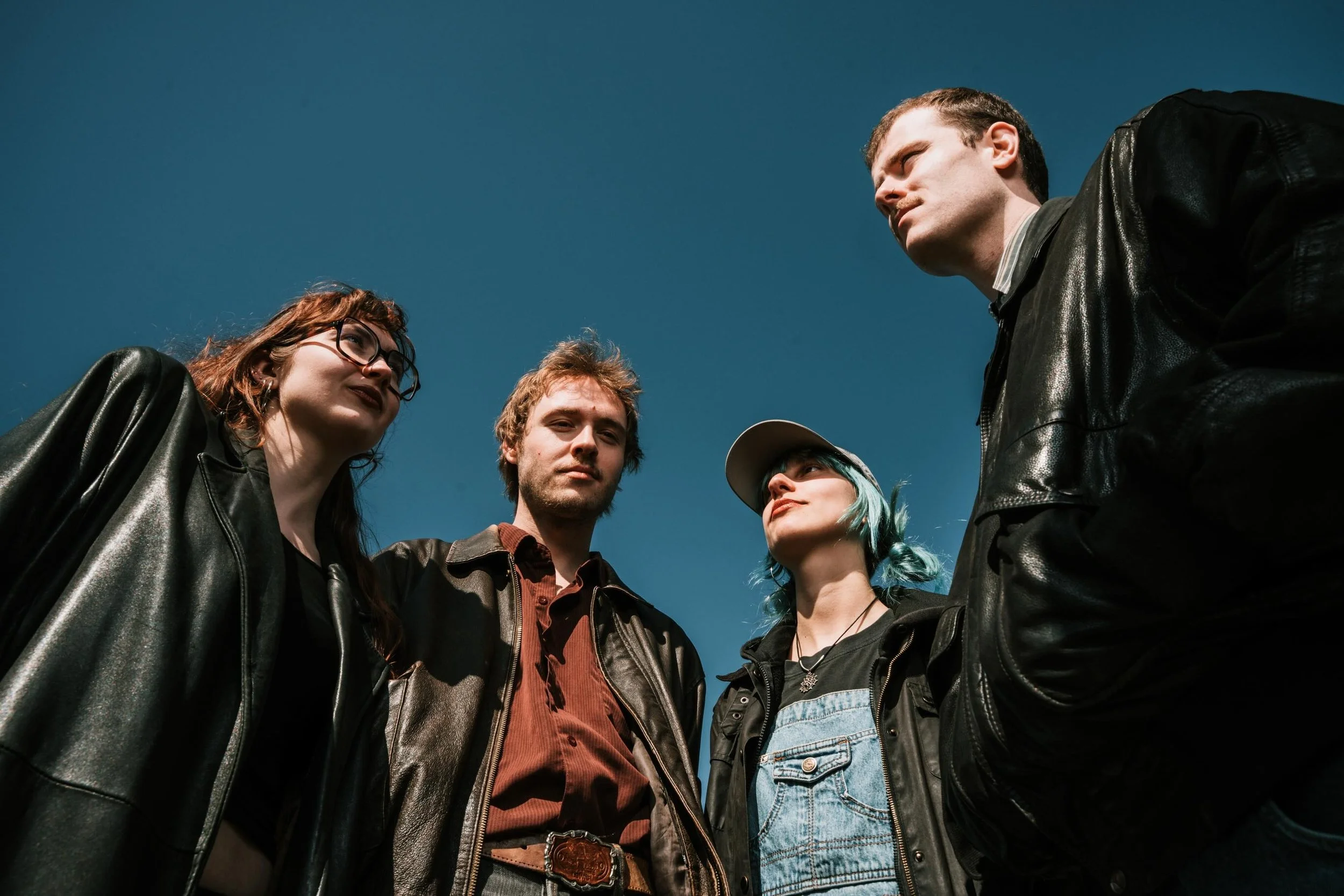
Mother Johnson, photographed by Hindele Zondervan
It’s hard to pinpoint what exactly caught my attention about Mother Johnson. I first heard of them through my friend Stan (of Rockpool Dramas fame), who produced their debut EP, and something just felt different about them. Maybe it’s because I love Rockpool Dramas, and trust Stan’s taste. Maybe it was the EP’s amazing cover art. But there was definitely something that drew me in. So I reached out, and we got in contact.
This might be dangerous to admit, but I sent the message before I even heard the music. This, as I later found, is not uncommon: the allure of Mother Johnson had their EPs sold out in their release party before they even started playing. I was glad to find I wasn’t alone in my fascination.
We met at a local café and I spoke with three of them (Kim, the drummer, was sadly absent). I could tell that they were friends first, and band members second—no doubt a contribution to the quality of their music.
Despite my relative nervousness, they treated me like I was already part of the group (something not uncommon for them, as I later found out). We spoke of their origin story, their first gigs, their process, Stan’s contribution to the EP, and the reality of being a DIY band in today’s current Amsterdam musical landscape.
How did you guys start?
Trym: I think it all started at this party and me and Shane were both there, but we didn't know each other yet. And there was a guitar, and we both wanted to play guitar, so we brought it out in the party [chuckles]. We were probably awful.
Shane: God yeah, it was really like two guys are here to do Wonderwall.
Trym: Yeah, and then I was like, “we should get together and jam at some point”. And then we did.
Shane: He didn't live far from where I was, only around the corner, so it was very convenient. At the same time I was also jamming a bit with my roommate Celia who came along a few times when I went to Trym’s. So that was was going well, and we’re like, “this is sounding quite nice." So the first song we did together was champagne, which actually used to be called happy and the lyrics were quite different. They were lyrics I wrote at around 18 years old about a boy that I liked and it was a bit stupid.
Emily: This is also when I met Shane for the first time, and we had this class on intersectionality. I just sat next to him and my favourite thing is that he started talking to me as if we were already friends. But we didn't know each other.
Shane: Listen, I needed a bass player.
Emily: No, he didn't know I played bass at the time.
Shane: I mean... I looked at her [laughs].
Emily: So we were friends right away which was so nice. And I mentioned that I played bass, but I didn't have a band to play with.
Shane: And I said, “we’re going to practice tomorrow night”.
Emily: So I was like, “okay, I’ll come”, since we were best friends already.
Shane: It was funny because we invited you over, and we were practising in Q Factory. Trym was fine with it, he's a very chill person, nothing bothers him. But Celia—who started singing—was like, “If we’re going to do this band thing, we can’t just pull people off the street” [laughs]. That day we were practising, and one of my best friends’ roommate was studying at the Conservatorium but had started drumming in the last month and wanted somewhere to do that. And I asked her to come along, and she booked the room for us at the Conservatorium and we practiced that day. And that’s how we met our drummer Kim, who had been drumming two weeks before she met us, and she’s amazing now.
But when we went to Q Factory, I had already signed us up for the Crea open mic. So we already had a gig even though we never even practiced. They put us at the end because they were like, “it’s a band, you guys are gonna rock”, and we were covering The Beatles [laughs]. We decided to do Eleanor Rigby, a song by The Black Keys, and Zombie by The Cranberries. So that was technically our first performance, which was 4 years ago. Then we did another open mic at the Waterhole, which was probably one of the worst things anyone has ever seen.
Trym: The room went quiet. They didn’t even applaud out of courtesy. They were shocked.
Shane: That was the first time that champagne was ever played live.
Emily: And german cities too.
Shane: And yeah, the crowd hated us. A lot of passive aggressive comments, a lot of, “you can tell it’s new. You guys were trying.”
Emily: It was the worst thing ever. We were horrible.
Trym: Even our friends were like, “it was... interesting.”
Shane: We still posted it on Instagram [laughs].
Emily: It was horrible. And then we had Cinetol coming up too.
Shane: That was our second gig. I had a friend who was organising a launch day for the student council who randomly had a bunch of money from the university and rented out Cinetol to do it. We opened there with all these super great amazing acts. Looking back it probably wasn’t great, but it felt like the best day of my life.
That’s amazing! So you started four years ago, second gig at Cinetol. Did you ever have a moment after a gig where you thought, “maybe we shouldn't do this”?
Emily: Should we talk about ‘Skek?
Shane: Oh my god ‘Skek was even worse. If you think the Waterhole was bad… ‘Skek was about 6 months after the Waterhole.
Emily: Yeah and Shane was like, “I can’t even touch my guitar after that one”. It was really bad. It was partially our fault because we just weren't that good, we were just starting. But we also had some mishaps with people in the crowd.
Shane: At ‘Skek, the stage quite small and the audience comes right up close to you, and I had my guitar on. When I went down to adjust a pedal, a drunk guy in the front row decided it would be funny to start un-tuning all of my strings, and I didn’t notice. So I went back up, we started playing the song, and I was strumming and I was like, “this is sounding really bad”. And at the time we were still so new that I didn’t even have a tuner so I had to—in this crowded bar—take out a guitar tuning app.
Emily: At like 2:30AM.
Shane: We’re the last band. So I quickly tune this up. Then we started playing, but because we started so late, they cut us off half way through the last song. The guy who was doing sound ran onto the stage and unplugged our guitars.
Emily: So I think after Waterhole we were a bit like “it’s ok, it's our first time.” We were a little bit more positive. But we definitely had gigs [like ‘Skek] when we were like, “we have to stop”.
Shane: I feel like sometimes I still have that attitude.
Emily: Yeah you do! After a bad practice Shane’s like, “I don’t even know if we were able to do music”. [The song] blue eyes, I feel like Shane especially went so back and forth about it because there was a period of time when we didn’t play it live anymore. But we never wanted to stop as a band. It was just very dramatic sometimes, we live for the drama [laughs]. But there’s certainly songs and elements where we were like, “we should just scrap this”. Once I called Shane and said, “I don’t think I should sing in the band anymore.” Because I was feeling so insecure. But we have this a lot, where we’re very… what’s the word you use?
Shane: Fatalistic. But it’s strategic gaslighting. Like, “Emily you can sing!” [laughs]
Trym: There is a disconnect between what we say and what we do. We say we’re never going to do it again, and then we do it again.
Shane: Our confidence is frequently on the ground here at Mother Johnson.
Emily: I think we don’t feel very polished.
“Huge vibes at a Mother Johnson gig. Come for the vibes, leave when the music starts.”
But not all music has to be polished.
Emily: No, definitely not. But there’s so many extremely technically talented musicians in the scene. They’re so good at their instruments, and I play three root notes. So it’s hard not to compare sometimes. But I think for a lot of people it’s not just about that, it’s also about the feeling, and I think we have a very good feeling with each other and I think that translates well into the music.
Shane: We make up for it in vibes [chuckles]. Huge vibes at a Mother Johnson gig. Come for the vibes, leave when the music starts.
Emily: A great example is that [at the EP release show] the merch sold out before we even started playing. So maybe it’s not fully about the music, but that’s okay.
But it is about the music, of course! When I was listening I wasn’t thinking, “they should be more technical”, I just loved it.
Shane: The whole thing? You liked all of it?
Emily: There was a few skips in there, on a five song EP [laughs].
Trym: There’s a few skips... Three skips maybe.
Shane: Four albums songs, one hit.
No, it’s genuinely really good. Really beautiful.
Shane: opener, that’s beautiful. That’s fun to play.
It’s such a good, well opener, it’s inviting you into this secret little world. [A loaded silence, and then]…
Shane: Do I say it?
Emily: Say it.
Shane: It’s about bottoming. [Another pause, then everything laughs]. And that’s all we’ll say about that. The name is a double entendre, as they say in France [laughs]. It’s the opener of the album and something is opened shortly after. But I think the riff came before all the stupid lyrics, and it was [EP producer] Stan’s idea to do this crazy five part harmony, which is also insane.
It’s so lush. It’s a very beautiful song about bottoming.
Shane: It really is, and that breakdown, and the drums… I really like that one.
Emily: I think it’s my favourite.
Shane: It is a lot of people in the band’s favourite.
Trym: It's my favourite on the EP. But I don’t know, maybe my all-time favourite could be something that’s not out yet.
Is it your favourite to play live, or when you listen to it?
Shane: God, it’s fun to play live, because I like to sing it. What I’m most nervous about when we play it live tends to be my singing. With the guitar, I have a lot of shit happening with the pedals where the technical stuff doesn’t really matter and it just becomes this big wishy, dreamy, shimmery sound. But the singing, you can’t hide behind as many effects. But what’s nice with opener is that if we play it first, I’m thrown into the deep end straight away. I have to start belting this really strenuous vocal. And it’s a nice way to just get it over with and the rest of the gig is a lot easier.
Emily: I think it’s also great for the crowd. It’s a very good start to what we’re doing. Shane’s vocals are [a lot of my friends’] favourite part of seeing us live. The passion, the excitement in how he sings… he has such a projecting voice, it’s very fun to listen to. I think [starting with] that song is good for the crowd to get excited. I also sing with Shane in that song, and I love singing with Shane. So I’m also very happy.
I have a lot of questions about the names of things. Why Mother Johnson? Who is Lindsay?
Shane: I will take a small bit of credit for the “Johnson” thing.
Emily: You made up the whole thing.
Shane: Ok I’ll take credit for everything [laughs].
Trym: I remember sitting on a terrace—also smoking cigarettes—discussing names and that was one of the first names.
Shane: Essentially what I liked about [the name] Mother Johnson is that"Johnson” is one of these names that is just so… boring. But to put Mother in front of it… I was thinking that our music can be a bit boring, but we have this little flair in front of it.
READ MORE | Tabby wants you to stay creative… despite everything
And Lindsay? How did that start?
Shane: We were thinking of names of places. It was originally Lindsey with an E for a little bit. That was a throwback to Stevie Nicks’ love affair with Lindsey Buckingham, at least for me.
Emily: I remember we were just saying place names, because we thought it was a very Midwest emo thing to do. And we have this kind of running joke So I was born in a place called Lindsey, and I always say, “I’m from Bobcaygeon but I was born in Lindsey” because Bobcaygeon doesn't have a hospital. And Shane, whenever people ask me where I’m from and Shane’s around he says, “Lindsay, Ontario”, he always says the full thing.
Shane: Lindsey Ontario, it’s very like… well, hi.
Emily: We were saying that could be good because it’s also a name of a person, then we were just kind of saying things with Lindsay. Then Shane’s roommate Dario just shouted “Lindsay, I miss you”.
Shane: And I think the songs on the album—besides opener—thematically are all about missing places. It’s all about going to different places, meeting new people, mourning old people, things like this. And the good parts of that, too.
Emily: It felt like it suited that vibe. Also, none of us were born here [in the Netherlands]. We’ve all moved here from other places. So I think that’s a big theme in our lives as well. We all moved here for a reason. But it’s easy to miss what you used to have, even if it wasn’t perfect. I think that’s kind of what the song sweet is about: going somewhere else where you might find love and community that you didn’t before.
Is that ambiguity something you try to keep in mind?
Shane: I think so. I think we’re drawn to it.
Trym: I think we like it when it arises.
Shane: For example, champagne was called happy for so long, and we thought it was too on the nose. And the lyrics to the song actually changed the day before I recorded them. Of course I wrote them when I was around 17, so you can do a bit more when your lyrics are abstracted, because then allows for freedom of interpretation. This is what I tried to do with champagne before, but then I still kept [the lyrics] “happy for you”, which is my least favourite one. It just reminds me of the stupid jealous teenager that I was when I was writing it.
And did Stan help at all with editing the lyrics, or did he just let you do your thing?
Shane: He helped with a lot of the music, but I wouldn’t say the lyrics.
Emily: I asked him when we first started this whole producing journey, “are you interested in knowing what the songs are about?” And he said, “no”.
Shane: [Laughs] She was so eager to tell him, and he was like, “it doesn't matter at all”.
Trym: But I think it’s better if he doesn’t know.
Shane: Yeah, but his influence is definitely there. For champagne I originally had this riff that I started with that was similar to opener, but Stan hated it. He was like, “just start the fucking song”. So Kim then started doing this [mimics drums], and we all came in at the same time, which is way better. Just start the fucking song [everyone laughs]. So it was his idea to layer a bunch of guitars and vocals on opener, for example, and to change up the ending of sweet as well.
Emily: A lot of the harmonies were his idea. And in blue eyes, there’s this beautiful part in the middle where breaks down, there’s acoustic guitars and it’s very atmospheric. When we were doing that, it was a beautiful day out and he had his window to his terrace open, and you could hear the sounds of birds and kids and stuff, and he said to Shane , “play the guitar outside”, and then he took a microphone and put it around so that we could hear the atmosphere.
He really has the ear for it.
Shane: Oh he does, yeah. He’s very attentive to a lot of different ways of doing production, which is why we really appreciate him. I know he gets a lot of influence from a lot of DIY stuff. He’s all about recording things in the room, not being afraid to make sure everything is tight, but then also that atmosphere. That moment with the guitar, he gave me some old acoustic guitar and I completely untuned everything. It sounds I’m just playing a few chords but I had tuned a bunch of them around in different ways to make sure it was right, so we needed the right ear to make that space in the song.
READ MORE | The lifelong poetry of Chico Buarque
Would you say that he is very technical? Because you guys were saying that you’re not, but do you think he makes up for that?
Shane: I think that’s why he’s drawn to us, because we mediate his technical brain.
Trym: And he gets to use it a lot with us, because we’re so not technical.
Shane: We’re like, “what is this?” And he's like, “that's a guitar”.
Trym: We’ve worked with other people before and it was not as comfortable. But working with Stan has been really nice. I always get the shakes when I’m recording, because this take might be the one that goes on the record forever. If everyone else is happy with it and I’m not, I’m gonna have to listen back to it for eternity and not be happy with it. But with Stan it felt a lot safer, it felt like he understood me. He just gets me [chuckles].
Emily: And he’s very good as a person with the band as well, his personality fits with us so well. He’s just so nice to have around. We’re kind of at each other a lot—obviously lovingly—and he’s not weirded out by it, he embraces it a lot, which is very nice. He’s not afraid to say something, which I really, really like about him as well.
Shane: And he’s not afraid to change things. His influence is definitely there.
“Just start the fucking song.”
Was there ever any moment where he wanted to change something, and you guys completely disagreed?
Shane: Yes, and he will not let it go [laughs]. It is [the song] sweet. He had made a completely different mix on sweet that was very influenced by a lot of 90s DIY stuff, garage rock, it was a bit more poppy. Everything was good, but for us it all felt a bit Mario Kart-y. And then we made him do another mix that was a bit more akin to how we play live, a lot more reverb.
Trym: A lot more reverb. It was like you took the same mix and put it underwater.
Shane: We were super happy with it, and he was not. In the album we made a little booklet that has a note from all of us and Stan’s note ends with “PS. I still think my original mix of sweet was a better treatment of the song”. So he will die on that hill, but God forbid a man is wrong about something.
Emily: He also thinks our songs should be shorter.
Shane: Yeah, but that’s his pop brain. Because our songs average about seven minutes.
Emily: For the EP we did cut things a bit shorter because when we play them live we make them a bit longer.
Shane: That’s how we write, we kind of write three songs in one. We have something set, and then there’s a breakdown or something completely different happens, then the end is different again.
Emily: Yeah we have different momentum. I have a solo in one of the unreleased songs. And I play it live way longer than I would on a recording. It’s just a different experience. So for the EP we do shorten. Except for blue eyes, which is quite long.
Shane: The kind of music we like to listen to is also a bit like this.
And in the bigger context of being a DIY band in Amsterdam, you’ve been playing for a few years, but is there anything since releasing the EP that changed or was unexpected?
Shane: Something about having the music out does restrict your freedom of playing songs live in a way, because a lot of people come and want to hear it a bit like the EP—which I don’t think is a bad thing. But now you have kind of almost a script.
Trym: But I would still do it differently live. When I see someone live I want them to do it slightly differently from how I’ve heard it in my headphones. You do have to stick to the to some kind of course, but I want some variation when I see a show. But I feel like the pressure is more off than ever in some ways, especially on stage.
Emily: Yeah, because now people can experience the song in its most “perfected way”. It doesn’t rely on just one performance. When you’re playing for someone you’re like, “this is how you will understand the song” and that puts some pressure. But if you have a version that’s recorded you can refer back to—and that you like—you have freedom to do what you want live because there’s always going to be this “real” version of the song. And it’s fun to have something to refer back to when you’re talking about the band. For trying to get gigs but also in social life.
“If you love music, if you love the scene, you should see smaller bands.”
When you’re trying to get gigs, do you do everything yourselves or do you have someone that helps you?
Emily: A lot of it is also just talking and meeting people. When we were first starting out, a lot of other bands at a similar level would ask me how we get so many gigs—because we would get a lot of random gigs, especially considering we had no music out. So I just always say, talk to a lot of people and kind of shove it down their throats.
Shane: You have to work a lot. Send a bunch of emails, go to venues, ask people how you can play, things like this. Also put on your own show.
Trym: Shane and Emily are amazing at getting gigs, and I’m not good at it at all. I really want to be better at it but people ask how you get so many gigs, and I’m also asking [laughs]. It’s very impressive and I aspire to be even half as good as they are at networking and managing stuff.
Shane: We’re very annoying. Sometimes I’m just like, “let me just run a gig”, and I’ll contact people. That’s also why we played that terrible gig at ‘Skek, because we had organised it. I sent a message in, I had a contact at ‘Skek. And the thing is, bands want to play. There are a lot of bands in the city, you send one message in a group chat you have a bunch of people flooding in.
Trym: I also think Amsterdam must be one of the greatest places to be in this kind of band. It’s ripe with opportunity, a lot of squat venues. At home in Oslo, you couldn’t be doing what we’re doing here, things are a lot more “official”.
Emily: We have Sad & Gazing, this shoegaze collective that we’re doing at OCCII, and the amount of DMs I get from bands asking to play the next edition, I can’t even listen to all of them. And they seem really cool! But there’s only so many Sad & Gazings we can do, even if they’re all amazing, I can’t book them all. If only.
Is it because there’s a lot of shoegaze bands but not enough shoegaze events?
Shane: Yes definitely, that’s how we pitched it to OCCII. When you have a scene like the DIY music scene in Amsterdam, you either play punk or you play pop. Obviously there’s an indie centre and stuff—maybe I’m being a bit black and white—but there was this kind of cohort of bands that were not hardcore masculine enough for the punk stuff, were doing things that were a bit more interesting than the standard pop stuff, and weren’t exactly indie because they were doing these crazy noises and stuff. And there was also this event in ACU called Come In Alone, which is another shoegaze night where we played, and they were having these events for a while, so I thought, “why not just do it?” We’ve had two events that were very successful so far.
Do you have a date for the next one?
Emily: No date, but the lineup has already been constructed.
And who made the cover for the EP? It's beautiful.
Emily: Shane’s beautiful roommate Ilinca.
Shane: She’s a wonderful artist, graphic designer. We sent her a bunch of photos that Emily’s partner Ben had taken. Because we recorded a lot in Stan’s bedroom, but we did a lot as well in OCCII. When we were there, Ben was taking a bunch of photos—and we wanted photos to be on the EP cover. So we sent Ilinca a link to all of these photos that Ben had taken. And she sent us a bunch of different designs in one day, and in this package of eight designs was the single cover with these two photos. And then she randomly said, “What if I take one of the photos of them together, zoom in on Shane’s face and completely fucking distort the image?” And that was a joke, but it turned out to be our favourite.
I love the texture that it ended up with.
Emily: She loves texture a lot.
Shane: Which is great if you're in a shoegaze band, it's all about the blur, the distortion. So big shoutout to her.
And do you have any fun plans for the future?
Shane: We want to do a bit of a tour now we have our music out. I really want to bring the band back to my hometown in Galway because there are so many really nice venues there. That’s something I’m trying to organise. While we’re there we also want to stop over in the UK. We’re also trying to do a bit of a Dutch tour. No recording plans yet. This is all being decided on Tuesday actually, we’re all meeting to talk about it.
Emily: Because this was such a big thing for so long, wanting to get our music out.
Shane: It was all leading up to this.
Is there anything you guys want to add?
Shane: Even if you don’t come to our gigs, support local live music. Go to small local gigs and make that artist your favourite artist. Because you’re gonna get music that’s just as good for €5 tickets. These bands coming out of the scene in Amsterdam... they’re so good. They’re doing crazy stuff.
Trym: I also think it’s a lot cooler. You feel like you’re a much bigger part of it.
“I think Amsterdam must be one of the greatest places to be in this kind of band.”
Would you say that’s the biggest challenge as a small band in Amsterdam, to get that kind of support? Or finances? Or both?
Emily: Honestly, yes, kind of both. I think people are always more likely to go see bigger artists. They’re more willing to spend the money. But when we ask for a ticket price, a fraction of the money goes to us. We're not making money.
Shane: That’s another issue. A lot of the venues that people want to play take a lot of money. This is why when you play the squats you can be guaranteed that the money would either go to a fundraiser or lot to you. Because it is expensive to do this, to buy instruments and record, make CDs and so on.
Emily: We have so many kind friends that do things for free for us, but that’s not the standard and it shouldn’t be. And that’s not always the case, and things get expensive if you don’t know people. So that’s a big takeaway, to go see local bands, support them. This is how you get big bands as well: they start from somewhere. I think if you love music, you can’t be spending all your money seeing massive bands at Ziggo Dome or AFAS. If you love music, if you love the scene, you should see smaller bands.
Shane: What if your favourite song is some bullshit that someone wrote in their bedroom?
Mother Johnson are performing tomorrow at Het Dorp with Rockpool Dramas and Tummyache. For free. Music starts at 22:00, don’t miss it. I’ll be there.